Helping business leaders turn values into collective impact
Leverage the most trusted and rigorous impact certification to strengthen your business, attract and retain talent, while building a
Impact Reports
B Corp Certification
Collective Action
How the work happens:
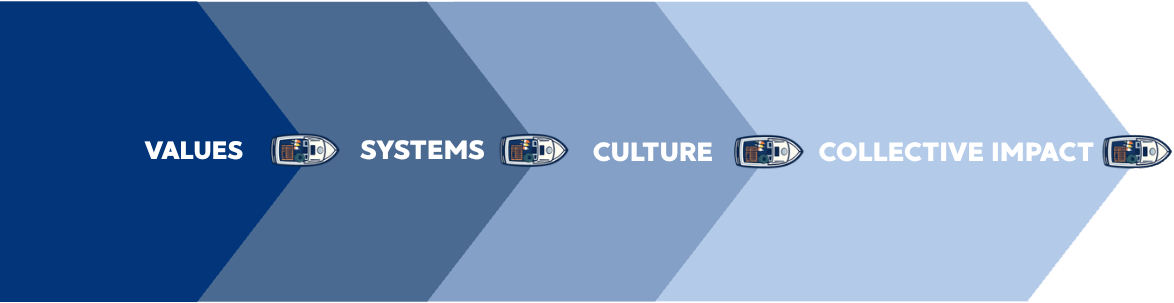
The Values to Impact Framework
Real impact does not happen through values alone. It happens when those values shape how a company operates, leads, and participates in the broader economy.
The Values to Impact Framework helps purpose-driven companies turn intention into action. The result is stronger culture, the ability to attract and retain talented people, deeper trust with customers, and brands that create value for people, planet, and the bottom line.
You might notice the boats in the graphic. We are based here in Portland, Maine where a working waterfront is part of everyday life, and it offers a simple way to think about how this work functions.
In this framework, your values are your navigation. They guide where you are headed and why the journey matters. Your systems are the lines and tools that keep the vessel operating and connected. Your culture is the crew, and the stronger the morale and trust among the crew, the farther and more successfully the boat can travel. And your collective impact is what your work brings back to the community, supporting livelihoods, ecosystems, and the broader economy along the way.
If your organization is ready to turn values into systems, culture, and collective impact, we would love to explore the journey with you.
-
Every impact journey begins with clarity.
In this stage we help organizations articulate the change they want to create and translate their values into a clear theory of change. Together we map how your business activities contribute to social and environmental outcomes and how those outcomes connect back to the long-term success of the company.
A strong theory of change turns values into something actionable. It helps leaders make better decisions, align teams around shared priorities, and communicate the purpose behind the work.
Because businesses evolve, we also revisit this framework year over year. This ensures your values, strategy, performance, and impact remain connected as the organization grows.
-
Values become real when they shape how a company operates.
In this phase we translate purpose into governance, policies, and operational practices that support measurable impact. To guide this work, we use the latest standards from B Lab as our primary benchmarking tool. These standards are among the most rigorous and comprehensive frameworks available for understanding how a business affects its workers, customers, communities, and the environment.
While many organizations pursue B Corp certification through this process, certification itself is not the only goal. Even for companies that do not intend to certify, the standards provide a powerful way to assess current practices, identify opportunities for improvement, and build systems that support long-term accountability.
The result is a business where impact is embedded into how decisions are made and how success is measured.
-
Systems set expectations, but culture determines how those expectations show up in daily work.
This stage focuses on building workplaces of belonging where people can contribute, grow, and stay. Through leadership development and universal design approaches, we help organizations create environments that attract and retain talented people who want their work to matter.
Strong cultures increase morale, strengthen collaboration, and help organizations retain the people who make their mission possible.
When culture aligns with values, the organization becomes stronger from the inside out.
-
No company creates systemic change alone.
The final stage focuses on identifying opportunities for collaboration, advocacy, and collective action. This may include participating in industry initiatives, supporting policy change, or joining coalitions working to address shared challenges.
Collective action allows businesses to extend their influence beyond their own operations and contribute to broader social and environmental progress.
By working together, companies can help shape markets, policies, and communities in ways that no single organization could accomplish on its own.
We Worked Well Together
Trusted by Impactful Organizations